
 back to overview
Schlossgarten Dieburg
Schlossgarten Dieburg
daily opened
A stroll along Ulmenallee leads to an idyllic island between Gersprenz and Herrngraben. This is where the French park begins, which Johann Philipp Ernst von Groschlag (1650–1716) had laid out in a representative manner just outside Dieburg.
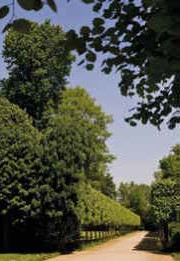
The designer Johann Ludwig Petri modelled the garden on the palace gardens of Versailles. The avenue of pollarded lime trees, newly planted in 1997, once again offers a view of the striking trapezoidal pond and the ‘little temple’. While Groschlag still missed the connection to the neighbouring Stockau Castle, his son Philipp Karl Anton later took up the axis. He aligned the ‘Dutch section’ with an obelisk, which can still be admired in the distance today. He brought the idea of the surrounding canals to Dieburg from his studies in Leiden.
His grandson Karl Friedrich Willibald finally expanded the grounds to include a classic English landscape garden, which was highly praised by garden theorist Christian Cay Lorenz Hirschfeld.
The special feature of the Schlossgarten Dieburg is the coexistence of these three different styles. The town of Dieburg, which acquired the site in 1863, has kept most of the land together over the centuries. As a result, the axes of the Baroque gardens can still be traced today.
Since 1988, the city has been dedicated to preserving this unique garden heritage. Historical structures are being restored in several stages. The main French avenue has been restored and leads to the renovated trapezoidal pond with its fountain. The transverse avenue is also growing and will become a magnificent promenade in the coming years.